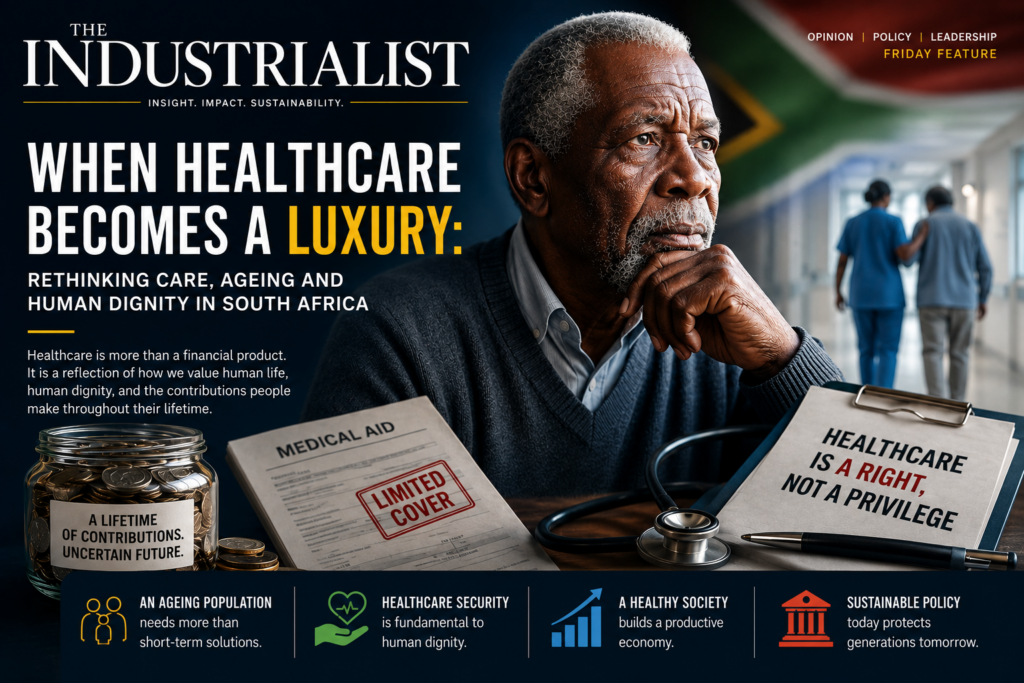
Medical Aid Contributions Are Not the Same as Healthcare
South Africans often assume that paying medical aid contributions means they are securing future healthcare.
The reality is more complicated.
Medical aid contributions are payments into a risk pool. They do not create an individual healthcare reserve, nor do they guarantee that a member will receive healthcare equal to the value of the contributions they have made over a lifetime.
Some members may claim significantly more than they contribute. Others may contribute for decades and require very little care.
This raises an important policy question.
Why does government subsidise medical aid membership through tax credits instead of directing a larger proportion of those funds toward strengthening universal healthcare access?
The current system rewards membership rather than care delivery.
An individual who contributes to medical aid for twenty years but rarely uses healthcare services has effectively financed the broader risk pool. Yet when they retire, become unemployed, or can no longer afford contributions, their access to private healthcare may disappear.
The medical aid scheme retains no long-term obligation to provide care based on historical contributions.
In effect, the individual financed the system without accumulating healthcare security.
This does not mean medical aids are failing to perform their intended function. Medical schemes operate as insurance products, not lifetime healthcare trusts.
However, it does raise a broader public policy question.
Should public incentives support private membership, or should they strengthen healthcare infrastructure that remains available throughout a citizen’s lifetime regardless of employment status, age, or income?
The objective of healthcare policy should not merely be healthcare financing.
The objective should be healthcare security.
A nation should measure success not by the amount collected in contributions, but by the certainty that every citizen can access quality care when they need it most.
The question policymakers must answer is simple:
Are we subsidising healthcare, or are we subsidising healthcare insurance?
The answer matters because they are not the same thing.
The Policy Debate: Are We Funding Healthcare or Insurance?
The debate surrounding South Africa’s healthcare future often focuses on the National Health Insurance (NHI), medical schemes, and healthcare financing. Yet perhaps we are asking the wrong question.
The real question is not who collects the money.
The real question is who guarantees the care.
Medical aid schemes operate as insurance products. They are designed to pool risk among members and provide financial protection against healthcare costs during the period of membership. They are not designed to guarantee healthcare access for life.
This distinction matters.
A South African may contribute to medical aid for decades while healthy, yet find themselves unable to maintain membership after retirement, unemployment, disability, or financial hardship. At that point, the contributions made over many years do not create a permanent entitlement to care.
The system worked exactly as designed.
The question is whether the design still serves the long-term needs of society.
Supporters of medical scheme tax credits argue that they encourage citizens to take responsibility for their healthcare, reduce pressure on public hospitals, and strengthen private healthcare capacity.
Supporters of NHI argue that public funding should follow the principle of universal access, ensuring that healthcare remains available regardless of age, income, employment status, or medical history.
Both perspectives seek sustainability.
Both seek better health outcomes.
Yet they differ fundamentally in their understanding of healthcare.
One views healthcare primarily through the lens of insurance and individual membership.
The other views healthcare as a social and economic asset that should remain accessible throughout a citizen’s lifetime.
This creates an important policy consideration.
Should public funds be used to subsidise private healthcare membership through tax credits, or should those same resources be redirected toward strengthening a universal healthcare system capable of supporting every South African?
The answer is not simple.
Private healthcare has played a critical role in expanding healthcare access, attracting investment, and supporting medical innovation. At the same time, the public healthcare system remains responsible for the majority of South Africans and carries the burden of ensuring equitable access.
Perhaps the future lies not in choosing one model over the other, but in asking a different question:
How do we create a healthcare system where contributions made during a person’s productive years translate into healthcare security during their most vulnerable years?
Because healthcare policy is not merely an economic discussion.
It is a discussion about trust.
Citizens trust that the systems they support today will support them tomorrow.
When that trust is weakened, the debate shifts from healthcare financing to healthcare justice.
The challenge facing policymakers is therefore not simply how to fund healthcare.
It is how to ensure that no South African reaches old age and discovers that decades of contribution did not translate into decades of care.
Building solutions for health, education, innovation, community, and human legacy.